
Contemporary society’s growing separation from nature, particularly in the design and development of the modern built environment, is partly a function of our increasingly indoor, urban, and technological-oriented existence. It reflects a deeply held belief that progress and civilization depend on the ever-expanding capacity to control, convert, and transcend nature…These modern constructions are often dominated by the use of human-made materials, artificial lighting, processed air, and sensory-deprived environments with little connection to the culture or ecology of the places where they occur.
Stephen Kellert
A MUST-SEE MOVIE
If you find some free time, this movie offers a great introduction to the topic: “Biophilic Design – The Architecture of Life”
I still have a few days before the start of my travels. As I work on coordinating the logistics, I am excited to share with you the locations I am planning to visit. Those include New York City, New Haven, New Canaan, Boston, Pittsburgh, Washington DC, Seattle, the Big Island and O’ahu, as well as multiple locations in San Francisco and around the Bay Area.
I will focus my research on spaces where we spend most of our time, that is workplaces and educational settings. As such, I will be visiting many offices and schools that are prime examples of biophilic design, including the CookFOX office in Manhattan, the Etsy office in Brooklyn, the Bertschi school in Seattle and the Hawaii Preparatory Academy Energy Lab in Waimea. The objective is to discover the most successful biophilic design applications, which can be adopted in other areas of design practice, including hospitality and residential.
My goal is to collect insights from experts, designers and users of biophilic spaces during the in-person visits. Traveling to the selected case-studies will allow me to survey the latest and most advanced applications of biophilic design, uncover motivations behind implementing this design approach, and assess tangible results arising from its application over time.
According to Stephen Kellert, biophilic design provides a “deliberate, systematic and informed approach to bringing beneficial contact with nature into the modern built environment.” In his various books, Kellert offers a framework that identifies and categorizes various elements and attributes of biophilic design. In his latest work, Nature by Design: The Practice of Biophilic Design, he identifies three experiences and 25 attributes of biophilic design. Building on the research by Kellert and other experts, the environmental consulting and strategic planning firm, Terrapin Bright Green, offers its version of the framework, identifying 14 patterns of biophilic design. That is the framework I will use as a tool to analyze biophilic design solutions applied in my case-studies.
Terrapin Bright Green’s publication “lays out a series of tools for understanding design opportunities, including the roots of the science behind each pattern, then metrics, strategies and considerations for how to use each pattern.” The patterns, as defined by them, include:
Nature in the Space
- Visual Connection with Nature
- Non-Visual Connection with Nature
- Non-Rhythmic Sensory Stimuli
- Thermal & Airflow Variability
- Presence of Water
- Dynamic & Diffuse Light
- Connection with Natural Systems
Natural Analogues
- Biomorphic Forms & Patterns
- Material Connection with Nature
- Complexity & Order
Nature of the Space
- Prospect
- Refuge
- Mystery
- Risk/Peril
As humans become increasingly disconnected from nature in our daily lives, the task of connecting people and nature in our built environment becomes even more urgent. Doing so will require intentional action, and we will have to purposefully unlearn of of our habitual ways of designing and constructing buildings.
Amanda Sturgeon
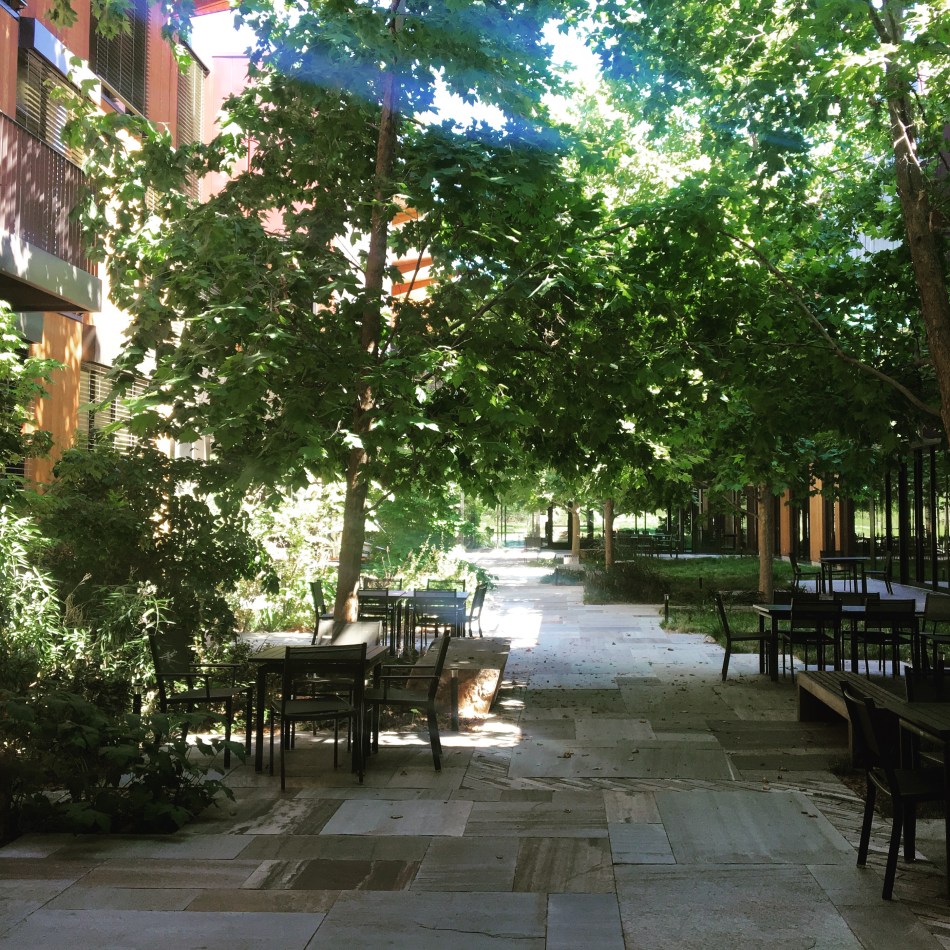
Featured Photo: David and Lucile Packard Foundation / Photo by Ewa Podgorska
 natuRE:engaged
0 comments on “Biophilic Design Framework”